

As the world’s largest copper clad laminate manufacturer, Kingboard Chemical Group has earned its position through consistent material quality trusted by PCB manufacturers and electronics engineers worldwide. For any PCB factory or PCB design team specifying board materials, selecting the right laminate from Kingboard’s lineup is a foundational decision that affects thermal reliability, regulatory compliance, and long-term product performance.
Among Kingboard’s most widely used substrates, KB-6160A vs KB-6164 vs HF-140 represent three distinct engineering choices — standard UV-blocking FR-4, lead-free process optimized FR-4, and halogen-free FR-4. This guide breaks down each material’s key parameters and application fit, so PCB buyers across the USA, Singapore, Australia, and Europe can make a precise substrate selection before production begins.
1. What Each Material Is Designed For
Before comparing numbers, it helps to understand the engineering intent behind each product.
KB-6160A is a UV-blocking FR-4 substrate (UV板) in the KB-6160 family. It shares the same Tg and Td as the baseline KB-6160 but is formulated for applications where UV resistance is a functional requirement — relevant in outdoor-adjacent assemblies and products with exposure to fluorescent or UV light sources during inspection or use. It is the default laminate for a wide range of standard PCB applications.
KB-6164 is Kingboard’s entry-level lead-free process laminate (适用無鉛製程,普通Tg). Despite being labeled “standard Tg,” its Td of 330°C and improved Z-CTE make it meaningfully more resistant to the thermal stress of lead-free soldering profiles than KB-6160A. It is the correct choice when RoHS-compliant manufacturing is mandatory and product reliability over thermal cycles matters.
HF-140 is a halogen-free (無鹵) FR-4 material — not a high-frequency substrate. The “HF” designation stands for Halogen-Free, not High-Frequency. Its resin system eliminates brominated flame retardants, meeting stricter environmental regulations while delivering a Tg of 141°C, Td of 350°C, and the lowest Z-CTE of the three at 3.3%. It is the right choice when end-product environmental certification (IEC 61249-2-21, JPCA-ES-01) or market regulations require halogen-free materials.
2. Official Technical Parameters (Kingboard Datasheet)
The following values are sourced directly from Kingboard Chemical’s published product specifications.
| Parameter | KB-6160A | KB-6164 | HF-140 |
|---|---|---|---|
| Product Description | UV板 (UV Blocking) | 適用無鉛製程,普通Tg | 無鹵,普通Tg (Halogen-Free) |
| Tg (°C) | 138 | 140 | 141 |
| Td (°C) | 310 | 330 | 350 |
| Z-CTE (%) | 4.3 | 3.5 | 3.3 |
| CTI | 175V | 175V | 175V |
| Lead-Free Process Fit | Marginal | Optimized | Adequate |
| Halogen-Free | No | No | Yes |
| UL Flammability | V-0 | V-0 | V-0 |
Tg measured by DSC method; Td measured at 5% weight loss by TGA; Z-CTE measured from 50°C to 260°C.
3. Reading the Tg Numbers Correctly
At first glance, the Tg values look nearly identical: 138°C, 140°C, and 141°C. This closeness is intentional — all three materials are classified as standard Tg products, not mid-Tg or high-Tg. The key differentiator is not Tg alone.
The more meaningful thermal reliability indicator in lead-free manufacturing is Td (decomposition temperature). When a board enters reflow at 260°C peak temperature, Tg determines when the resin softens — but Td determines when it starts to irreversibly break down.
- KB-6160A’s Td of 310°C provides a 50°C margin above peak reflow. This is technically sufficient but leaves limited buffer for multi-pass reflow or rework.
- KB-6164’s Td of 330°C adds a 20°C safety margin over KB-6160A — meaningful in high-mix assembly environments where boards may see multiple reflow passes.
- HF-140’s Td of 350°C is the highest of the three, providing the most robust thermal stability. This partly compensates for its primary positioning as an environmental-compliance material rather than a thermal-performance material.
4. Z-CTE: The Hidden Reliability Factor
Z-CTE (coefficient of thermal expansion in the z-axis) is a metric that directly correlates with via barrel reliability and plated through-hole (PTH) fatigue life. As the board heats during reflow, the substrate expands in all three dimensions. Z-axis expansion stresses copper-plated vias — if expansion is too high, via cracks develop over thermal cycles, leading to intermittent failures in the field.
| Material | Z-CTE (%) | Via Reliability Assessment |
|---|---|---|
| KB-6160A | 4.3 | Standard — suitable for typical via densities and board thicknesses |
| KB-6164 | 3.5 | Improved — better for fine-pitch BGA pads and multi-layer boards |
| HF-140 | 3.3 | Best of three — favorable for dense HDI and fine-pitch assemblies |
For designs with small-diameter vias (≤0.2mm), high aspect ratios (>8:1), or BGAs with tight pitch (≤0.8mm), the lower Z-CTE of KB-6164 and HF-140 translates directly into longer product life — particularly important for industrial and automotive-adjacent products sold into markets with extended warranty expectations.
5. Halogen-Free: When HF-140 Is Required
The European Union’s RoHS Directive and the IEC 61249-2-21 standard impose restrictions on halogenated flame retardants in electronic assemblies. Traditional FR-4 materials — including KB-6160A and KB-6164 — use brominated epoxy resin systems for flame resistance. While these materials meet UL94 V-0 flammability requirements, they do not meet halogen-free specifications.
HF-140 replaces brominated flame retardants with phosphorus-nitrogen or inorganic filler-based systems, achieving equivalent flame resistance without halogens. This is a regulatory requirement — not a preference — for:
- Products sold under the EU’s WEEE/RoHS framework requiring halogen-free PCB materials
- Japanese market electronics following JPCA-ES-01 green procurement guidelines
- Corporate supply chain sustainability programs with halogen-free PCB mandates (common among Tier-1 OEMs in Germany, Japan, and South Korea)
- Server and data center hardware following telecom industry halogen-free adoption
If the end-market does not require halogen-free certification, HF-140 adds material cost without functional benefit for standard PCB applications.
6. Application Selection Matrix
| Application | Best Choice | Reason |
|---|---|---|
| Consumer electronics, general PCB | KB-6160A | UV protection, cost-effective, adequate Td |
| LED stage lighting driver boards | KB-6164 | Lead-free reflow compatible, lower Z-CTE |
| Industrial power supply / inverter boards | KB-6164 | Higher Td (330°C), better via reliability |
| Automotive electronics (non-powertrain) | KB-6164 or HF-140 | Thermal reliability + potential halogen-free mandate |
| EU/Japan market consumer products | HF-140 | Halogen-free compliance required |
| Server / telecom infrastructure PCBs | HF-140 | Industry halogen-free adoption standard |
| PCB cloning / reverse engineering | KB-6160A or KB-6164 | Match original BOM spec and cost profile |
| Outdoor / UV-exposed assemblies | KB-6160A | UV-blocking resin formulation |
7. Cost and Sourcing Comparison
| Factor | KB-6160A | KB-6164 | HF-140 |
|---|---|---|---|
| Relative Material Cost | Baseline | +10–20% | +15–30% |
| Panel Availability (PRD region) | Excellent | Excellent | Good |
| Lead Time (prototype) | 2–5 days | 2–5 days | 3–7 days |
| Processing Compatibility | Standard FR-4 | Standard FR-4 | Requires halogen-free compatible chemistry verification |
| Certification Documentation | Standard | Standard | HF declaration + IEC 61249-2-21 reference |
HF-140 introduces modest process verification overhead — some etching chemistries and surface finish processes used for standard FR-4 require compatibility confirmation before running on halogen-free substrates. Most established PCB manufacturers in the Pearl River Delta have standard HF-140 process qualifications in place.
Closing
The comparison of KB-6160A vs KB-6164 vs HF-140 is ultimately a three-axis decision: UV resistance and standard process economics (KB-6160A), lead-free thermal endurance and via reliability (KB-6164), or halogen-free regulatory compliance and superior Td (HF-140). The Tg values are nearly identical across all three — engineers who specify material based on Tg alone will miss the more significant differentiators in Td, Z-CTE, and environmental certification status.
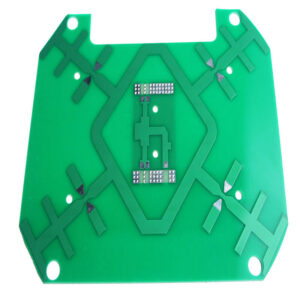
6160A-double-sided board
Guangzhou Mineng Electronics Co., Ltd. (CHNPCB) manufactures single-sided, double-sided, and aluminum substrate PCBs using Kingboard KB-6160 series copper clad laminates, serving clients across the USA, Singapore, Australia, Europe, and the Pearl River Delta supply chain. Our Baiyun District, Guangzhou production facility supports both standard and lead-free process requirements, with full material traceability and quality documentation. Contact CHNPCB to discuss laminate selection for your next PCB project and request a fabrication quote.
Please send the GERBER files and detailed requirements to: PCB@CHNPCB.COM