

When comparing 22F vs CEM-1, most buyers are really asking one question: how much performance do I actually need for this application, and how much am I willing to pay for it? Both are paper-based laminates commonly used for single-sided PCBs, but they sit at different points on the cost-to-performance curve, and picking the wrong one can mean anything from a slightly higher unit cost to a board that fails in the field. This article breaks down what separates these two materials so you can specify the right one with confidence.
What Is 22F Laminate?
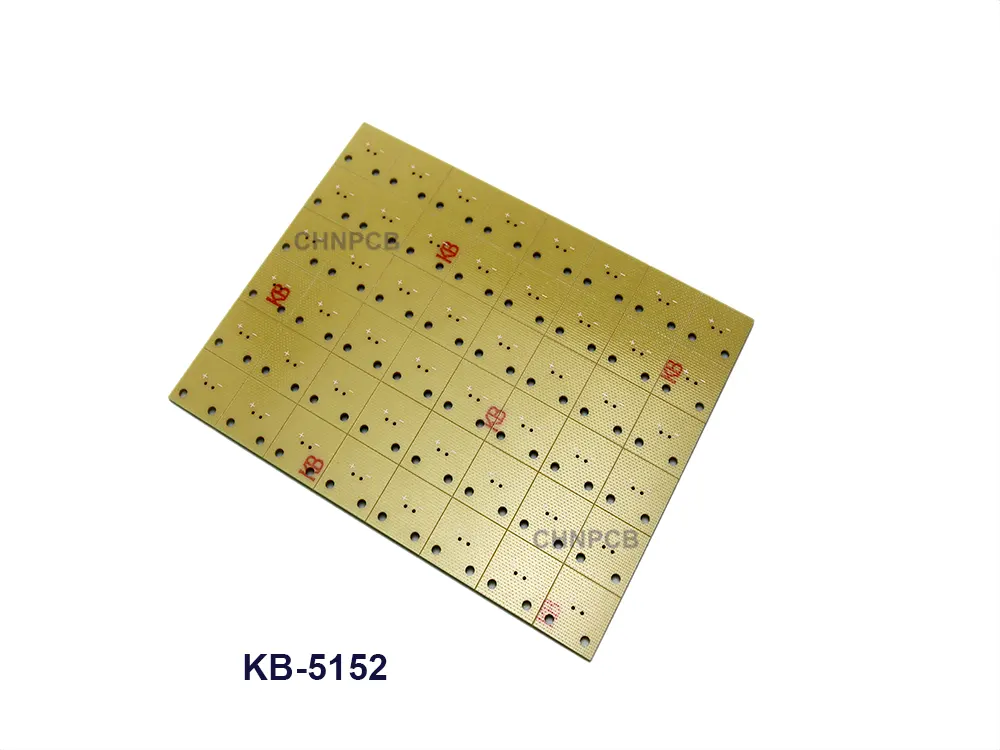
22F is a paper-based phenolic laminate, built from layers of kraft paper impregnated with phenolic resin and pressed under heat. It’s one of the most economical substrate grades available, and it has been a staple of low-cost consumer electronics manufacturing for decades. Its main advantages are low material cost and excellent punchability — 22F sheets cut and die-stamp cleanly, which is why it’s still popular for high-volume, low-complexity products like simple toys, remote controls, and basic household appliances.
The trade-off is that pure phenolic paper laminates like 22F have relatively poor moisture resistance and lower mechanical strength compared to glass-reinforced materials. They can also be more prone to warping and delamination under thermal stress, so they’re best reserved for products with a short service life, low reliability requirements, or a tight cost ceiling.
What Is CEM-1 Laminate?
CEM-1 (Composite Epoxy Material-1) is a step up in construction. It uses a paper core impregnated with epoxy resin, topped with a thin layer of woven glass fabric on the surface. This hybrid structure gives CEM-1 noticeably better mechanical strength, improved moisture and heat resistance, and better dimensional stability than a pure paper-phenolic board like 22F, while still remaining significantly cheaper than full glass-woven FR-4 laminate.
Because of the epoxy resin and glass fabric surface, CEM-1 also tends to have a smoother, whiter appearance and better solder heat resistance, making it a common choice for consumer electronics that need somewhat higher reliability than 22F can offer — items like power adapters, small household appliances, and lighting control boards.
22F vs CEM-1: Key Differences at a Glance
| Property | 22F | CEM-1 |
|---|---|---|
| Core Material | Paper + phenolic resin | Paper core + epoxy resin + glass fabric surface |
| Cost | Lowest | Low-to-moderate |
| Moisture Resistance | Weaker | Improved |
| Mechanical Strength | Lower | Higher |
| Punchability | Excellent | Good |
| Solder Heat Resistance | Lower | Higher |
| Typical Use | Low-cost, low-reliability products | Cost-sensitive products needing moderate reliability |
How to Choose Between 22F and CEM-1
The decision usually comes down to three questions: What’s the expected service life of the product? What environment will the board operate in (humidity, temperature swings, vibration)? And how tight is the budget per unit? If you’re producing something disposable or extremely price-sensitive with mild operating conditions, 22F is often the more practical choice. If your product needs to survive more handling, a bit more heat during assembly, or slightly more demanding environmental conditions — without jumping all the way to FR-4 pricing — CEM-1 is usually the better middle ground.
It’s also worth noting that neither material is a substitute for FR-4 in applications involving high-density routing, multilayer boards, or high-reliability requirements such as automotive or industrial control equipment. For those, glass-woven epoxy laminate remains the standard.
As a PCB company from China, CHNPCB works with all three grades — 22F, CEM-1, and FR-4 — and helps customers match the material to the actual demands of their product rather than defaulting to the most expensive option out of caution.
If you’re weighing 22F vs CEM-1 for an upcoming production run, our team can review your application and recommend the most cost-effective laminate for your specifications. Contact us at PCB@CHNPCB.COM to discuss your project.